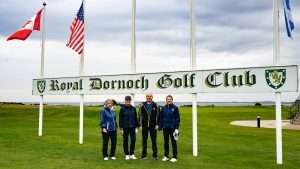
US mergers and acquisition advisor Doug Pendleton enjoys a passion for links golf, the history of the game and its roots in Scotland.
Here, in his second blog for “Golf Highland,” he recalls a magical evening at Portmahomack, after savouring the delights of the famous Royal Dornoch Championship Course on the other side of the Dornoch Firth earlier in the day.
Doug has been visiting many of the marvellous off-the-beaten track golf courses which the Scottish Highlands has to offer.
Follow Doug on Instagram @journeytoscratch
ENDURING MEMORIES OF A MAGICAL EVENING AT PORTMAHOMACK
THE light is peeking through damp clouds and another Highland sunset is unfolding over the Dornoch Firth.
My son, Trevor, is gripping his club, intently assessing another birdie putt. I take a moment to look around.
Standing on the green, watching Trevor, are six golfers, me included.
We each have only a few golf balls and tees in our pockets – and the three clubs we’d previously and thoughtfully selected (in my case the 7 iron, wedge and putter).
Looking to my left, I see a field of bright yellow flowers flowing from the far side of the fairway over a gentle hill.
Directly behind the green, sheep mingle closely together under a warm, misty rain.
An iconic church is on my right, enclosed by an ancient stone wall.
Surrounding the old church are gravestones recalling people who once lived here and perhaps even played golf on the hole where I am now standing.
There are no other tourists on the golf course. I can be sure of that because we are the only golfers on the course.
It’s dusk and raining, so I get it, but this course would rarely be on tourists’ radar.
It has blind shots, humps, and random hummocks. It’s a pass-by golf course, yet it has the elements of an authentic links that I love. It’s not polished, which is precisely why we are here!
It was Trevor and his friend’s first trip to Scotland, and I wanted them to experience and hopefully embrace the joys of links golf.
In many ways, Portmahomack is more of a traditional Scottish course than even the world famous Royal Dornoch.
It’s certainly not been tweaked or modified to help tourists have an easier time at it.
It’s just here, played by Scots who love their golf and a local course where little has changed for a hundred years or more.
We’d played 18 holes earlier at Royal Dornoch but had wanted more.
We’re thousands of miles from home, with 18 hours of sunlight at our disposal that we felt should not be squandered.
After a light dinner and a few pints of Tennent’s lager at the Royal Dornoch clubhouse, we headed round the Dornoch Firth towards the spit of land and the lighthouse that we had spotted earlier.
Arriving at the Portmahomack Golf Club, the car lot was empty. We hadn’t even come across any cars on the last few miles to the course.
We pushed our green fees into the honor box and our tees into the ground. We were ready to go.
We had the course to ourselves, and the match was on! Tim, JT and I were the “Old Guys,” playing against Trevor, Josh and Mike, the “Young Guys,” in a three-on-three-ball, three club scramble in the rain on a wee Scottish nine-hole golf course.
Trevor made the putt, of course. The Old Guys never had a chance. A few hours earlier, he had played well on Royal Dornoch and was still draining the putts at Portmahomack.
Our crew were lucky enough to tee-up at many incredible star courses on our trip that year, including Royal Dornoch, Kingsbarns, Carnoustie, The Old Course and more.
Yet, for the price of a few pints, our random three-club Texas Scramble at Portmahomack in the waning sun that evening was one of the most memorable and enjoyable experiences on our whole trip!
Portmahomack (Tarbat) Golf Club (Par 68) is famed for its sunsets and undulating seaside terrain, with fine views of the Dornoch and Moray Firths. It’s one of only two villages on Scotland’s east coast which faces west and playing Royal Dornoch in the evening you will spot the sun striking windows and rooftops. A nine-hole lay-out was in play as far back as the 1890s and a new seven-hole course opened in 1909. Nowadays the nine-hole course covers more than 2450 yards and back tees offer a 5188 yard 18-hole challenge.